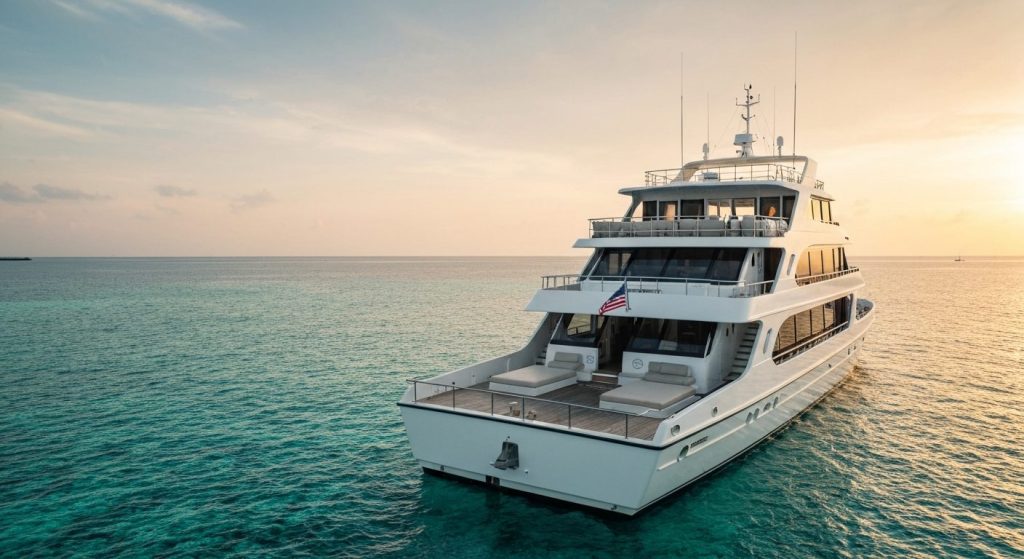
A raja ampat luxury yacht charter is a fully crewed private boat hire in Raja Ampat, based out of Sorong or Waisai, with your own vessel, cabins, chef and tailored route. On this page I walk through how that actually works in practice on traditional wooden phinisi and modern motor yachts, what drives the real cost, and how our Sorong/Waisai-based team can help you plan it clearly.
Raja Ampat luxury yacht charter, defined
A charter in Raja Ampat means you book the whole boat – not just a cabin – for your own group.
You choose the dates (within the vessel’s schedule), you shape the route with the cruise director, and the crew runs the ship, tenders and kitchen for you.
At Luxury Raja Ampat Liveaboard Charter we focus on:
– Traditional raja ampat phinisi sailing vessels (wooden, Bugis-built) in the 2–16 guest range
– A small selection of larger motor yachts and liveaboards we arrange through partner operators, clearly disclosed as such
– Departures from Sorong and Waisai that cover Misool, the Dampier Strait, Piaynemo, Wayag and adjacent Eastern Indonesia diving routes on request
You get:
– Private ensuite cabins or suites, often including at least one private master cabin phinisi raja ampat guests love to claim first
– A full Indonesian and international crew: captain, engineers, deckhands, chef, stewards, and – for diving charters – a cruise director and dive guides
– Tenders or dinghies for diving, beach landings and lagoon exploration
– Daily planning with your cruise director to adjust plans to weather, tides and guest energy levels
No bareboat charters, no DIY navigation.
This is hosted, crewed exploration in a remote marine area that rewards good planning and local knowledge.
Our role: Sorong-based operator, own phinisi + trusted partners
We are a Raja Ampat operator based year-round between Sorong and Waisai, operating our own Indonesian crewed phinisi fleet and managing planning for a handful of partner yachts.
So to be transparent:
– We own and operate: A small fleet of traditional wooden phinisi sailboats and compact dive liveaboards in the 2–14 guest range. These are the boats we know down to the galley storage and compressor hours.
– We arrange via partners: Larger steel motor yachts and resort-linked liveaboards, plus a few Indonesia luxury phinisi outside our home fleet. These vessels belong to vetted operators; if you proceed with our partner they may pay us a referral fee at no extra cost to you.
We do not attach our name to boats we have not inspected or that do not run regular seasons in Raja Ampat or nearby Eastern Indonesia waters.
You get honest matches between group size, budget, route ambition and vessel, instead of a list of every hull floating in Southeast Asia.
If you want to check dates, cabin layouts or compare vessels side-by-side, our reservations desk can map options for your dates and group size – just plan your trip and mention you prefer WhatsApp for planning if that’s easiest.
Traditional wooden phinisi vs modern motor yacht
Both work well in Raja Ampat. They just feel different.
Below is a simple comparison to help you think about fit for your group.
| Feature | Traditional wooden phinisi | Modern motor yacht / steel liveaboard |
|---|---|---|
| Build & style | Hand-built wooden hull, Bugis heritage, tall masts; warm interiors with lots of teak. | Steel or composite hull, contemporary lines; brighter, often with larger salon areas. |
| Typical capacity | 2–16 guests in 3–7 cabins. | 6–24 guests in 4–12 cabins. |
| Ride & stability | Gentle motion; can feel more movement in open water; very comfortable at typical Raja Ampat cruising speeds. | Generally more rigid; often faster in transit; some have stabilisers for choppier crossings. |
| Deck space | Expansive open sun decks, shaded lounges under sails, lower freeboard near water. | Multiple levels, often more enclosed spaces, higher vantage points. |
| Dive facilities | Dedicated dive deck with compressors, tank racks, camera tables; tender-based diving. | Similar facilities; some have larger gear rooms and more camera work space. |
| Fuel & range | Efficient at Raja Ampat speeds; ideal for standard Misool–Dampier–Wayag circuits. | Higher fuel use; better for fast repositions across Eastern Indonesia. |
| Atmosphere | Classic “phinisi liveaboard luxury experience” – sail silhouette, wooden cabins, intimate feel. | More like a compact expedition ship or contemporary yacht; often more separation between indoor and outdoor spaces. |
For most Raja Ampat itineraries – 7 to 12 nights, 4–12 guests, mix of diving and island time – a crewed phinisi charter raja ampat gives the most character and more than enough comfort.
A modern motor yacht becomes interesting if:
– You have a larger group (12–20+ guests).
– You want to cover longer distances quickly (for example yacht charter eastern indonesia diving that also includes Banda Sea or Halmahera on the same trip).
– Someone in the group strongly prefers a contemporary yacht aesthetic.
We charter both, and we’re clear about which vessels we operate directly and which we arrange via partner operators.
What a Raja Ampat phinisi charter includes
Exact inclusions vary by boat, but a typical Indonesia luxury phinisi charter in our network includes:
Cabins and onboard space
Most vessels offer:
– 3–7 guest cabins for 2–16 guests total
– At least one private master cabin phinisi raja ampat guests often choose for the principal couple or group organiser
– Ensuite bathrooms with hot water
– Individually controlled air-conditioning
– Separate crew quarters so your group has privacy
Shared spaces usually include:
– Shaded outdoor dining area
– Indoor salon or lounge, often with a small library and charging space for cameras
– Open sun deck with loungers or daybeds
– Dedicated dive deck with kit-up benches, gear storage, showers and camera rinse tubs
On a smaller luxury phinisi sailboat charter indonesia (for example 2–6 guests) you give up a bit of volume but gain a very private feel. On mid-size phinisi liveaboards, group members can spread across two or three distinct lounging areas.
Crew and service
Even the smallest phinisi boat charter raja ampat usually sails with:
– Captain and first officer
– Engineer(s)
– 2–4 deckhands
– Chef and 1–2 stewards
– Cruise director and dive guides (for dive-focused charters) or an expedition leader and snorkel guide (for non-diving or mixed charters)
The crew handle:
– Navigation and safe anchoring in Raja Ampat’s many reefs and channels
– All meals and drinks service (usually full board plus snacks; alcohol policies vary)
– Housekeeping of cabins and common areas
– Diving operations: tank fills, gear handling, loading and guiding from tenders
– Beach setups and logistics for visits to piers, villages, viewpoints and lagoons
Service is friendly and relaxed – you quickly get to know names – but structured enough that diving, mealtimes and excursions run smoothly.
Diving and snorkelling operations
On a dedicated diving charter you can expect:
– 2–4 dives per day (conditions and energy levels permitting)
– Tender/dinghy diving with back-roll entries and pick-ups by the tenders
– Nitrox on many, but not all, vessels (we’ll flag this specifically)
– Small dive groups, often 1 guide for 4 or fewer divers
– Flexible plans to rotate between advanced current sites and gentle reefs or mangroves
Snorkellers are well looked after in Raja Ampat: many signature reefs around Piaynemo, the Dampier Strait and Misool rise close to the surface.
We do not promise specific critter sightings. Raja Ampat is very rich, but manta rays, sharks or particular macro creatures can never be guaranteed.
Food and dietary needs
Expect a mix of:
– Indonesian dishes: grilled fish, sambal, fresh vegetables, rice, soups and curries
– Simple Western options: eggs, salads, pasta, barbecues, light desserts
– Fresh fruit and snacks between dives
We can usually accommodate vegetarian, vegan, gluten-free or other dietary requirements with advance notice.
Supplies in Sorong have improved a lot, but very specialised ingredients may not always be possible; we’ll be honest about that during planning.
Signature Raja Ampat routes for luxury phinisi & yacht charter
Charter routes are tailored around your interests, dates, and how many nights you have on board. Below are the frameworks we build around most often.
Misool focus – luxury phinisi liveaboard Misool
Misool is far south of Waisai, around 8–12 hours’ sailing depending on boat speed and sea state.
It rewards groups who have at least 8–10 nights to play with.
Highlights on a Misool-focused charter might include:
– Dense, fishy reefs and soft coral walls in the Misool Marine Reserve
– Shallow reef plateaus ideal for wide-angle photography
– Lagoon and karst formations you explore by tender or kayak
– Quiet anchorages with fewer other boats, especially early and late in the main season
Many of our own phinisi do extended seasons around Misool between roughly November and April, adjusting to wind and swell patterns year-by-year.
Dampier Strait, Piaynemo and central routes
The central Raja Ampat area is accessible even on shorter charters of around 5–7 nights.
Typical stops include:
– Dampier Strait: high-energy drift dives such as Cape Kri and nearby reefs; sandbanks and channel snorkelling; good manta cleaning stations in season
– Piaynemo: classic karst islets, a short staircase up to the viewpoint, calm lagoons suited to paddleboarding or gentle snorkelling
– Arborek and surrounding islands: jetty snorkels, village jetty visits, local handicrafts
This is the most flexible region for mixed groups that combine avid divers, snorkellers and guests who just want clear water, island views and relaxed days on deck.
Wayag and northern routes
Wayag sits to the far north of Raja Ampat.
Reaching it takes patience: from Sorong you might spend 1.5–2 days transiting northward, usually with dives or snorkels along the way.
On a raja ampat private yacht charter sorong to the north you might:
– Start in Sorong or Waisai, work through Dampier and Piaynemo, then push north to Wayag
– Spend a full day in Wayag’s lagoons, hiking one or two viewpoints and using tenders to reach beaches and sandbars
– Return south via alternative reefs, or end at a northern pickup point if arranged
To do this route comfortably, budget 9–12 nights on board. Shorter attempts compress the schedule too much for most groups’ preference.
Extended Eastern Indonesia diving itineraries
Some of our partner motor yachts and a few phinisi run yacht charter eastern indonesia diving routes that connect Raja Ampat with:
– Halmahera and Morotai
– The Banda Sea and its offshore seamounts
– The Bird’s Head Peninsula coastal sites
These longer routes – 10–14+ nights – work best for highly dive-focused groups and require careful seasonal timing.
They are not available year-round, and ships may have to reposition from other Indonesian regions, which affects cost.
How long to charter for?
As a planning baseline:
– 5–7 nights: Central Raja Ampat – Dampier Strait, Piaynemo, nearby islands. Minimal long crossings.
– 8–10 nights: Add Misool or Wayag, or deepen time in both Dampier and Misool.
– 9–12+ nights: Combine at least two major regions (for example Misool + Dampier + Piaynemo, or Dampier + Piaynemo + Wayag).
Most of our raja ampat phinisi charters cover around 200–450 nautical miles in a week depending on route – enough to feel you’ve travelled, without spending all day under engine.
Who a Raja Ampat charter suits (and who might prefer cabins on a scheduled trip)
Chartering the whole boat makes sense if:
– Honeymoon or celebration trip: Couples who value privacy often charter a smaller phinisi with 1–3 cabins. You may pay more per person, but you gain a yacht entirely to yourselves and perhaps a close friend couple.
– Families: Having your own schedule and no strangers on board relaxes things with children or teenagers. You can mix shorter snorkels, sandbank stops and village visits around adult dives.
– Groups of friends: Groups of 6–12 divers or mixed diver/non-diver teams often find a raja ampat luxury yacht charter cost per person competes well with individual cabin prices on high-end scheduled liveaboards.
– Corporate or hosted groups: Charters work well for leadership retreats, photo workshops, or hosted trips where you want a contained, private environment.
A scheduled departure, booking individual cabins, can be better if:
– You are 1–4 people and happy to share the boat with others
– You prefer predictable, fixed itineraries without needing to choose every detail
– You want the lower price point of a shared departure in high season
We handle both: full charters and scheduled cabin bookings on our own boats and on partner vessels in Raja Ampat.
The right answer depends on group size, flexibility and your budget.
Raja Ampat luxury yacht charter cost: what really drives price
Charter prices in Raja Ampat vary widely.
Instead of quoting a single number, here is how the range typically looks and what shapes it.
Indicative price ranges (last verified June 2026)
For a full-boat charter:
– Smaller traditional phinisi (2–6 guests, simpler fit-out): Around US$4,500–8,000 per night for the whole boat, depending on season, inclusions and exact capacity.
– Mid-size phinisi (6–12 guests, higher finish): Roughly US$7,500–15,000 per night, again for the whole vessel, on typical Raja Ampat routes.
– Larger motor yachts / high-spec steel liveaboards (10–20+ guests): Often from US$12,000–25,000+ per night, with a wide spread depending on size and features.
Spread over a group, many charters land in the region of US$3,000–7,000 per person for 7 nights, but this is only a broad guide; season, boat and route can shift this substantially.
All of these figures are indicative only.
Exact offers depend on your dates, final route, and which vessel we confirm.
Main cost drivers
Several factors move the dial on raja ampat luxury yacht charter cost:
– Season: Peak months in Raja Ampat usually attract higher rates and more limited flexibility on routing.
– Vessel size and finish: A compact, well-kept wooden phinisi with 3–4 cabins will cost less than a large steel expedition yacht with multiple decks and high crew count.
– Route and fuel: Adding long transits – for example Sorong–Misool–Wayag in one trip, or reposition voyages to and from Raja Ampat – increases fuel use and often adds surcharges.
– Group size: The total cost for the boat is similar whether you sail with 6 or 10 guests, so per-person cost drops as you fill the available cabins.
– Diving vs non-diving: Dive charters carry added costs for dive staff, compressors, tanks, and maintenance, while a purely snorkel or leisure charter can be slightly more economical.
– Special extras: Private guides, yoga teachers, photographers, or high-end wine lists add to the base rate.
On our side, we’ll quote clearly:
– What is included (meals, soft drinks, diving, local transfers, park fees)
– What is excluded (alcohol, certain permits where applicable, gratuities, domestic flights)
We never ask for payment before you have a written offer and clear terms from us or, on partner boats, from the operating company we connect you with.
Logistics: starting and ending in Sorong or Waisai
Most Raja Ampat charters start or end in:
– Sorong (SOQ): The main air gateway, with a runway of around 2,650 m and regular domestic flights from Jakarta, Makassar, Manado and other Indonesian hubs.
– Waisai: The main town on Waigeo in Raja Ampat, reached by fast ferry (around 2–2.5 hours) from Sorong.
Typical patterns include:
– Sorong–Sorong roundtrip: Simplest for flights; works well for Misool focus or Dampier + Piaynemo.
– Sorong–Waisai or Waisai–Sorong: Useful for optimising time on board and reducing backtracking.
– Sorong–other port: For extended Eastern Indonesia routes heading to Halmahera, Banda or beyond, we’ll advise viable alternatives case by case.
Our reservations team helps coordinate:
– Airport pickup and transfer to the harbour or ferry
– Ferry tickets between Sorong and Waisai if needed
– Any required overnight stays in Sorong at the start or end of your trip
We do not issue international flight tickets, but we can share current patterns and typical same-day connections so your agent or online booking can align with realistic port times.
Permits, park fees and local regulations
Raja Ampat is a protected marine area with specific permits and conservation tags required.
Current practice (subject to change by local government) usually includes:
– A Raja Ampat Marine Park entry fee, valid for a defined period, payable per person
– Additional fees or local coordination for special activities such as visiting certain caves, cultural sites or conservation zones
On our own boats we usually:
– Build park fees into the charter quote, or list them clearly as a separate line item
– Handle the actual administration of permits with the relevant offices and checks
On partner vessels, their policies may differ slightly; we will flag how they handle this in their quote.
In all cases we follow current local regulations and adjust as rules evolve.
How planning and booking works with us
Chartering a yacht in Raja Ampat involves a series of decisions. We try to keep the process structured and calm.
1. Clarify your priorities
It helps if you come to us with:
– Approximate dates or a window (for example “second half of January”)
– Group size and rough mix (divers, snorkellers, children, non-swimmers)
– Your main aim: diving-heavy, mixed activities, photography, relaxed family time, or a honeymoon-focused trip
– A sense of budget range, even if broad
We do not ask you to have a route in mind; that is what we shape together.
2. Shortlist vessels
Based on those inputs we’ll:
– Present a short list of suitable phinisi and/or motor yachts, showing their capacities, cabin layouts and indicative rates for your dates
– Clarify which are owned and operated by us, and which are partner boats run by other companies
You can then compare:
– Phinisi vs modern motor yacht options
– Larger boat (more space, potentially lower per-person cost with a big group) vs smaller, more intimate vessel
– Cabin layouts that work best for couples, singles, children or sharing arrangements
3. Sketch a route and length
Together – often over a call or WhatsApp – we refine:
– How many nights you want on board
– Priority regions (for example “Misool + Dampier, no need for Wayag this time”)
– Special interests: manta habitats, mangroves, village visits, freediving, photography, birdwatching
We always keep realistic distances and seasonal patterns in mind.
The goal is a route that feels full but not rushed.
4. Confirm and hold dates
Once you have chosen a vessel and we have confirmed availability:
– We or our partner operator place a temporary hold on your dates
– You receive a written offer with inclusions, exclusions, payment schedule and cancellation terms
– A deposit is then requested to secure the booking
For partner vessels, contracts and payments are typically with the operating company; we remain in the loop for planning support.
5. Pre-trip planning and preferences
In the months and weeks before departure we gather:
– Passport details for permit and manifest purposes
– Dive certifications and recent dive history for each diver
– Dietary needs and cabin preferences
– Any occasion to celebrate on board (anniversary, milestone birthday, honeymoon)
We then finalise a day-by-day outline, with the understanding that wind, swell and park regulations may require adjustments once you are on the water.
If you are ready to start this process, the best step is to plan your trip with a brief note of group size, month, and your preferred way to communicate (many guests use WhatsApp for quick questions and updates).
Why book through a Sorong/Waisai-based charter operator
You can arrange a Raja Ampat charter via general yacht brokers anywhere in the world.
Some do a good job. Others list every boat they can find without much filtering.
Our added value is rooted in being physically based here and running our own ships:
– We know local conditions first-hand. Currents on a site like Cape Kri, wind at certain anchorages in January, how long the ferry really takes on a rough day.
– We see vessels regularly. Boats in our core network are ones we or our close colleagues step aboard often, not just see in brochures.
– We think in cabins, tenders and compressors, not just brochures. My job is mapping real capacities, bunk shapes, and how many divers can be in the water per tender without crowding.
– We are transparent on relationships. No one can pay to change what we publish; if you proceed with our partner they may pay us a referral fee at no extra cost to you.
That mix – direct operational experience and open disclosure – is what we hope makes this page genuinely useful as you compare options.
Is a Raja Ampat phinisi charter right for you?
A few simple questions can help you decide:
– Do you have a group of at least 4–6 people who can travel at the same time?
– Are you comfortable making some shared decisions about route and pace?
– Do you prefer a more personal, ship-like feel over a larger “resort at sea” vibe?
– Is your budget flexible enough for a whole-boat rate, knowing that per-person cost usually improves as you fill the cabins?
If you answered yes to most of these, a raja ampat phinisi or small yacht charter can be a very good fit.
If you are still unsure, we can also quote both options side-by-side: a whole-boat rate on a smaller phinisi versus cabins on a scheduled departure, for the same dates and region.
That way you can see the trade-offs clearly.
To get those comparisons for your real dates and group size, send a short message via our plan your trip form and note that you’d like to chat via WhatsApp; we’ll reply from our Sorong office during local working hours.
FAQs: Raja Ampat phinisi & yacht charter
How far in advance should I book a Raja Ampat luxury yacht charter?
For peak months many boats book 9–18 months ahead, especially for popular holiday weeks. Outside peak demand, 6–9 months is often enough, and we sometimes find shorter-notice options if your dates are flexible.
Is Raja Ampat suitable for non-divers on a charter?
Yes. Many itineraries combine world-class diving with calm snorkelling, sandbanks, viewpoints like Piaynemo, lagoon explorations and village visits. We simply balance the schedule so non-divers have relaxed options while divers are in the water.
What experience level do I need for diving in Raja Ampat?
Confident Open Water divers with recent practice can enjoy many sites, but the region also has strong-current dives better suited to Advanced-level and above. On charter we can adapt the mix of sites to the group and split dives when needed, with easier options for less experienced guests.
Can children join a Raja Ampat private yacht charter?
They can on many vessels, and families are common on private phinisi charters. Age limits differ by boat, and some have policies on very young children for safety reasons. We’ll match you with vessels comfortable hosting your children’s ages and adjust the itinerary accordingly.
Do I need to be worried about seasickness on a phinisi?
Raja Ampat is partly sheltered, but you will feel some motion, especially on longer crossings. Traditional wooden phinisi have a gentle roll that many guests find manageable. If you are prone to seasickness, bring medication that works for you and we’ll plan routes to minimise time in rougher open water where possible, though conditions can never be fully controlled.