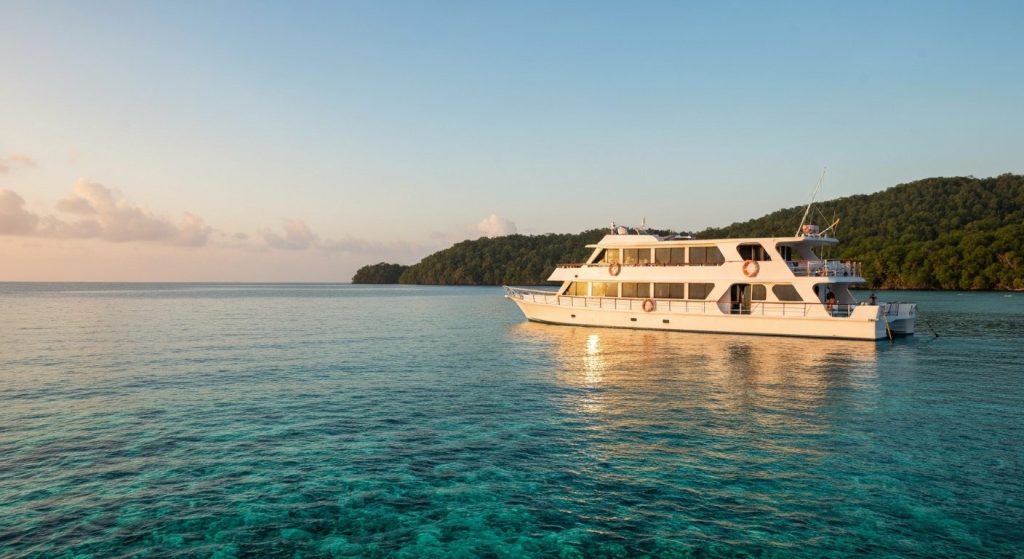
Raja ampat luxury liveaboard trips combine a fully crewed yacht with a dedicated diving operation, moving you between remote reefs, lagoons and manta cleaning stations while you sleep. On this page we explain how our own Raja Ampat dive liveaboard fleet works, what “luxury” and “dedicated dive” actually mean here, and how to choose the right boat for your group and your diving style.
—
What “Luxury & Dive Liveaboard” Really Means in Raja Ampat
In Raja Ampat, the phrase raja ampat luxury liveaboard is used for a wide range of boats. Some are private-yacht style phinisi with a high crew‑to‑guest ratio and strong dive support. Others are more simple dive ships with shared cabins and a focus on maximum bottom time.
Our role as a Sorong/Waisai‑based operator is to be very clear about which is which.
We run our own crewed liveaboard fleet for private charters and small-group scheduled departures. For some larger vessels and a few land-based add‑ons, we work with vetted partner operators; if you proceed with a partner they may pay us a referral fee at no extra cost to you. No one can pay to change what we publish, including on this page.
Below is how we break down the boats we actually send guests on.
Two clear categories: comfort‑first vs. dive‑first
Most serious divers here end up choosing between:
- Premium comfort “yacht-style” boats — fewer cabins, larger suites, more social space, fine‑tuned service, and still a fully equipped dive deck.
- Dedicated dive liveaboards — everything is built around the dive operation: big gear-up areas, camera benches, nitrox banks, big tenders, and earlier starts.
The best raja ampat liveaboard for you sits somewhere on that line. Some of our vessels lean towards comfort, some towards dedicated diving; all meet a baseline we hold to on safety, crew training and marine-park compliance.
—
Core Standards on Our Raja Ampat Dive Liveaboards
Here is what we consider non‑negotiable on any raja ampat premium liveaboard we own or book regularly.
Cabins: Ensuite, air‑conditioned, and sized for real people
- Private bathrooms in all guest cabins. No shared heads in the corridor.
- Air‑conditioning with individual cabin control. Nights can be hot and humid; sleeping badly ruins diving.
- Capacity usually in the 8–16 guest range on our preferred boats. Enough people for a good atmosphere, not so many that you feel anonymous.
- Bed layouts that match your group: double beds for couples, twin bunks for friends, a limited number of triples/quad family cabins on some boats.
On the comfort‑heavy vessels, cabins run larger, sometimes with desks and extra storage. Dedicated dive ships often give a bit more space to the dive deck instead. Both can still be the raja ampat best liveaboard for the right diver.
Dive deck set‑up: built for actual divers
Function on the dive deck matters a lot more than glossy photos.
On our own dedicated dive liveaboard Raja Ampat charters, and on our preferred partner boats, you can expect:
- One clearly marked station per diver for tanks and BCD, with space to kit up without knocking others.
- Rinse tanks separated for cameras vs. masks/computers.
- Stable ladders and side‑entry platforms on the tenders, which you will appreciate after a 70‑minute current dive at Cape Kri.
- Shaded areas for surface intervals and suiting up.
If you are travelling with serious camera gear, we will actively steer you towards boats with wide, fixed camera tables and good charging. That is one of the big differences between an acceptable dive ship and a raja ampat best dive liveaboard for photographers.
Compressed air, nitrox and safety systems
A raja ampat liveaboard nitrox included package is now fairly common at the higher end, and strongly preferred for repetitive diving.
We look for:
- Nitrox 32% available for all dives, either included in the package or clearly priced as an add‑on.
- Regularly maintained compressors and filters with logged service intervals.
- Oxygen kits and first‑aid on both the main vessel and dive tenders.
- Radios and GPS on the tenders; lifejackets and throw lines ready on deck.
- Clear gas analysis procedure with each diver checking and signing their mix before diving nitrox.
If you are nitrox certified, Raja Ampat is one of the places where the upgrade makes a very real difference to your day‑to‑day comfort and safety. If you are not, we can discuss options: some guests complete their nitrox course onboard, subject to instructor availability and conditions.
Guides and group sizes
Big, loose groups and strong current do not mix. Our default standard:
- Max 4 guests per dive guide for certified fun dives, often less on smaller charters.
- All guides certified through a major agency (PADI/SSI/CMAS) and with local site experience.
- Deck crew trained to assist with entry/exit and gear handling, not just drive the boat.
On a small group liveaboard Raja Ampat charter, we can usually keep buddies and families in their own guide unit, which makes a big difference to how relaxed the dives feel.
—
Key Dive Regions and Signature Sites Our Itineraries Cover
We write each itinerary around seasons, park rules and the actual conditions we see each year, not around marketing slogans. Below is how our raja ampat dive cruise routes generally break down, based on a mix of our own logs and accepted regional patterns.
Misool: Soft corals, swim‑throughs and sharks
Misool in the south is often the highlight of a raja ampat scuba liveaboard for guests who like bright soft corals and reef structure. Many trips run 7–10 nights to give Misool enough time.
Expect:
- Steep reefs and pinnacles covered in soft corals and sea fans.
- Good chances of reef sharks, schooling fusiliers and jacks.
- Swim‑throughs and caverns in some zones; these are guided only, with clear limits based on your experience.
Currents in Misool can be moderate to strong on certain sites, especially around point reefs and smaller seamounts. We plan dives around tide tables and on‑site checks; some dives here will be “negative entry” and require good buoyancy and descent control.
Cape Kri and Dampier Strait: fish density and current training ground
Cape Kri is one of the best known sites in the region and often a centrepiece for more advanced raja ampat manta liveaboard routes through the Dampier Strait.
Characteristics:
- Very high fish biomass — large schools of snapper, surgeonfish, barracuda, sometimes wobbegong sharks and turtles.
- Currents from mild to very strong, including down‑currents on certain tides and depths.
- Depth usually 5–30 m; the life is often thickest at 15–25 m.
At Cape Kri and similar sites, we strongly prefer divers to hold at least Advanced Open Water (or equivalent) and 30+ logged dives, with prior current experience. That is not a legal rule; it is a practical safety threshold we know from being out here every season.
Blue Magic: pelagic traffic on a compact reef
Blue Magic is a classic raja ampat dive liveaboard target between Sorong and Waisai. It is a small seamount that rises from deeper water to recreational depths, with:
- Potential for oceanic and reef mantas at cleaning stations (not guaranteed).
- Schools of barracuda and trevallies hunting in current.
- Compact structure where groups need to stay aware of each other.
Because of its size and positioning, Blue Magic can get busy in high season. Our captains will adjust timing to avoid peak congestion where possible.
Manta Sandy and nearby cleaning stations
Most raja ampat manta liveaboard itineraries that pass the Dampier Strait will aim for at least one dive at Manta Sandy or an alternate cleaning station nearby.
Here:
- Dives are usually relatively shallow (5–18 m) and often conducted from fixed sand “waiting areas” to protect the cleaning stations.
- Briefings focus on behaviour — where to sit, how to keep low, and how to avoid blocking cleaning routes.
- Manta sightings are seasonal and not guaranteed, though certain months and tides improve the odds.
These are some of the gentler dives in terms of exertion, so they work for a wide range of certification levels, including newer divers, as long as buoyancy is under control.
Wayag, Piaynemo and the limestone islands
Not every raja ampat dive cruise is only diving. Many charters include time in the iconic island landscapes of Wayag or Piaynemo.
Expect:
- Short hikes up limestone ridges for wide views over the lagoons.
- Lagoon snorkelling and beach time between dives.
- Kayaks or SUPs on some boats for quiet exploration of mangroves and bays.
These days are often favourites for mixed groups in which not everyone wants four dives a day.
—
How To Choose the Best Raja Ampat Liveaboard for You
Reading brochures and liveaboard listing sites can be confusing. Many claim to be the raja ampat best liveaboard without much detail on why.
Below is a side‑by‑side comparison of typical guest priorities.
| Priority | Comfort‑focused premium yacht | Dedicated dive liveaboard |
|---|---|---|
| Main goal | Space, quiet, service, strong diving | Maximum, flexible diving, functional comfort |
| Cabins | Larger, more suites, more storage | Compact but practical; all ensuite/AC on our picks |
| Guest capacity | Usually 8–14 | Usually 12–16 |
| Dive schedule | 3–4 dives/day | Up to 4 dives/day more routinely |
| Nitrox | Often included in rate | Included or fixed daily surcharge |
| Photographers | Good, but check camera table size | Usually excellent camera work areas |
| Non‑divers | Very comfortable: more decks, lounges | Good but more dive‑centric atmosphere |
| Price (indicative) | Higher per night | More value per dive |
Questions to ask yourself before choosing
- How many dives a day do you really want? Four dives a day for 10 days sounds exciting. By day six, some guests prefer three dives and more time watching the scenery from the sun deck.
- How strong is your current comfort level? Sites like Cape Kri and Blue Magic can be run for intermediate divers with conservative planning. If you are newer, we will likely recommend more time on gentler reefs and slopes.
- Are there non‑divers or very casual divers in your group? For mixed groups, the extra space and non‑dive amenities on the more yacht‑like vessels can be worth the higher nightly rate.
- Is serious photography a core focus? If yes, a dedicated dive liveaboard Raja Ampat itinerary with space for housings and a patient pace on cleaning stations is usually a better fit.
If you want to talk this through with someone who looks at currents and logbooks for a living, plan your trip with our team via email or WhatsApp. Share your certifications, number of dives, who is coming, and what kind of days you imagine, and we can match you with the right liveaboard profile rather than just the highest price tag.
—
Trip Length, Seasonality and Typical Itineraries
How many days do you need?
Travel time to Raja Ampat is significant. Once you have made it to Sorong, most guests prefer to stay out:
- 7–8 days / 6–7 nights for a Dampier Strait‑focused raja ampat dive liveaboard (often including Cape Kri, Blue Magic, Manta Sandy, and central reefs).
- 9–12 days / 8–11 nights for routes that include both Misool and Dampier, or that reach up to Wayag or into more remote zones within the marine park.
Shorter private charters (4–6 nights) are possible in central Raja, but you will cover less ground. These can still be excellent if your priority is relaxed diving and you have limited time.
Season patterns
Raja Ampat is technically accessible year‑round, but sea conditions and rainfall vary.
Broadly:
- October–April — more raja ampat manta liveaboard trips run this window, especially around the Dampier Strait. Seas are often calmer, though localized squalls happen.
- May–September — fewer liveaboards operate, but sites are quieter. Some Misool areas see more swell, and certain boats shift regionally.
Our own fleet scheduling is based on annual conditions we observe, and we adjust individual itineraries for wind and swell forecasts as departure dates approach. We never guarantee specific sites in advance; instead we design a set of goals for each route and then select from them based on actual weather and current.
—
Indicative Costs and What Affects Them
We do not publish fixed prices for a reason: there are many moving parts, and rates change with fuel, park regulations and season. That said, you need ballpark numbers to plan.
Based on our current contracts and our own boat operating costs, last verified June 2026, here is a realistic range for liveaboard diving Indonesia in Raja Ampat:
- Shared‑cabin diver, scheduled departure on a quality raja ampat scuba liveaboard: around US$350–650 per person per night, depending on the vessel, cabin type and season.
- Private full‑boat charter for smaller, more premium yachts (8–12 guests): often in the range of US$4,000–9,000 per boat per night, again varying widely with size, year, and level of finish.
Shorter trips are sometimes slightly higher per night; longer trips can offer better value per dive.
What your liveaboard rate usually includes
On our own liveaboards and most of the partner vessels we charter, base rates typically include:
- Accommodation in an ensuite, air‑conditioned cabin.
- All meals, snacks, tea/coffee and drinking water onboard.
- Up to 3–4 guided dives per full dive day, subject to conditions and your own profile.
- Tanks, weights and belts.
- Basic onboard kayaks/SUPs where available.
Common exclusions:
- Raja Ampat Marine Park entry permit — this is a per‑person park fee, set by regional authorities. Amounts and payment procedures can change; we will quote the current figure in your trip proposal.
- Alcoholic drinks and espresso‑based coffees.
- Gear rental (BCD, regs, dive computer, wetsuit, torch).
- Nitrox — sometimes included, sometimes a daily add‑on for nitrox‑certified divers.
- Fuel surcharges on longer, remote charters if applicable at the time of booking.
Ways to align budget and expectations honestly
- Decide what truly matters — is it more dives, more space, or a specific region like Misool? That choice can shift you by a full price band.
- Travel as a complete group — filling 8–12 berths on a private charter often works out better per person than booking the same level of boat cabin‑by‑cabin.
- Be flexible on exact dates — shoulder‑season trips can give you similar conditions at a friendlier price.
If you want a detailed quote based on your group size and preferred month, plan your trip with our reservations team. We are happy to send a few clear options, explain the differences, and hold a provisional cabin while you review.
—
Safety, Certification Levels and Dive Site Difficulty
I spend most of my time looking at conditions and site profiles, so this section matters a lot to me.
All information below is guidance, not a replacement for your onboard dive professional’s briefing or final say.
Certification levels: minimum vs. comfortable
For a typical raja ampat dive liveaboard with mixed sites (walls, slopes, mild‑to‑strong current), we usually see:
- Open Water — workable for many of the calmer reefs, sheltered bays and manta cleaning stations, especially if you are comfortable in the water and willing to skip some deeper/current‑heavy dives.
- Advanced Open Water (or equivalent) — highly recommended so you can safely enjoy the full range of sites down to 30 m. This is the level at which most of the classic “fish‑soup” dives stay within your training limits.
Rescue Diver and above is welcome, especially for those who enjoy understanding the safety picture more completely, but not required for our typical itineraries.
Currents and practical expectations
Raja Ampat is known for nutrient‑rich water. That is part of why the reefs are so healthy. The same moving water means:
- Some dives will be drifts, where the tender drops you upcurrent and follows your bubbles.
- Other dives, especially on seamounts, will rely on using the reef structure for shelter and moving in stages.
- There can be vertical current components (up‑ and down‑currents) near walls and corners. Guides brief these clearly, and we adjust depth, timing and site choice based on tides.
On our charters, no one is ever forced into dives beyond their comfort level. If a site is running harder than expected, we will move to a gentler option.
Visibility and water temperature
Visibility varies by region and season but is commonly in the 15–30 m range on many sites, with occasional drops after heavy rain or plankton pulses.
Water temperature is generally warm, often around 27–29°C (81–84°F). Many divers are comfortable in a 3 mm full suit; colder‑sensitive divers sometimes prefer a 5 mm, especially on longer trips with many days of repetitive diving.
—
What We Operate Ourselves vs. Arrange Through Partners
Honesty about this is important.
- Our own crewed liveaboard fleet — We directly operate a small number of crewed yachts and dedicated dive liveaboards based from Sorong/Waisai. Our staff handle the crew contracts, maintenance, provisioning and daily operations. Communications, payments and itinerary design for these boats are handled by our in‑house reservations team.
- Trusted partner vessels — For groups that need more capacity, specific cabin layouts, or particular dates we cannot cover with our own boats, we have long‑standing relationships with other Indonesian liveaboard operators. In those cases, we are very clear in your proposal which boat is a partner vessel. No one can pay to change what we publish; if you book with one of these partners through us they may pay us a referral fee at no extra cost to you.
- Land‑based extensions — We can add nights in Sorong, Waisai and selected island resorts before or after your cruise. These are always arranged with disclosed partners and integrated into your transfer plans.
In all cases, our own team remains your planning contact and helps align what is promised with what is actually realistic for the season and boat.
—
How We Help You Plan Your Raja Ampat Liveaboard
Here is the typical flow once you reach out:
- Initial call or WhatsApp chat — We ask about your group size, certifications, previous liveaboard experience, dates and any “must have” regions (Misool, Wayag, etc.).
- Shortlist of options — Usually 1–3 itineraries with different combinations of comfort level, days and price range, all available for your dates.
- Technical dive input — If currents, nitrox, or specific macro or wide‑angle goals matter to you, I review your shortlist and add site‑level notes in plain language.
- Hold and confirm — We can typically hold cabins or full‑boat charters for a limited time while you coordinate flights and group details.
- Pre‑departure briefing — Before you fly, you receive a detailed PDF with packing guidance, park permit updates, and what to expect from your specific route and boat.
You can start this process at any time — even just to get a feel for seasons and budgets — by contacting our team to plan your trip. Email is fine; many guests prefer WhatsApp for quicker back‑and‑forth once we have sent options.
—
FAQs: Raja Ampat Luxury & Dive Liveaboards
How far in advance should I book a Raja Ampat liveaboard?
For peak season (roughly October–April), 9–18 months ahead gives you the widest choice of boats and cabin types, especially for full‑boat charters. Shoulder‑season and last‑minute spots are sometimes available closer in, but options narrow quickly on the better vessels.
Is nitrox really necessary in Raja Ampat?
Necessary, no. Strongly recommended, yes. Many itineraries offer 3–4 dives a day, often in the 18–30 m depth range. Nitrox, used within your computer’s limits, helps manage nitrogen loading and can make you feel less fatigued over a multi‑day trip. We favour raja ampat liveaboard nitrox included packages or clear, simple nitrox pricing so there are no surprises onboard.
Can beginners join a Raja Ampat dive cruise?
Yes, but with some caveats. Open Water divers with good buoyancy can enjoy many sheltered reefs, bays and manta cleaning stations, especially on routes designed with a mixed‑experience group in mind. Strong current sites like Cape Kri or Blue Magic may not be appropriate for every beginner on every tide. Your onboard pros have the final say, and we are happy to design gentler itineraries for groups of newer divers.
Do you guarantee specific dive sites or manta encounters?
No. We plan each itinerary around a set of target regions and sites, but the exact dive plan depends on wind, swell, current, other boats and safety considerations on the day. Manta rays and other wildlife are never guaranteed; we schedule to give you good chances without promising what nature may or may not provide.
What’s the difference between booking direct with you and through a big liveaboard listing site?
Booking through us connects you directly with a Sorong/Waisai‑based operator that actually runs its own boats in Raja Ampat and works closely with a small circle of partner vessels. We combine honest, on‑the‑water knowledge of currents and conditions with clear explanations of each boat’s comfort and dive setup. Large listing sites aggregate options but may not know the current reality of specific boats or routes in as much detail.